FRANCHISE LAW
Franchising Mobile Food Trucks: Territory, Permits, FDD
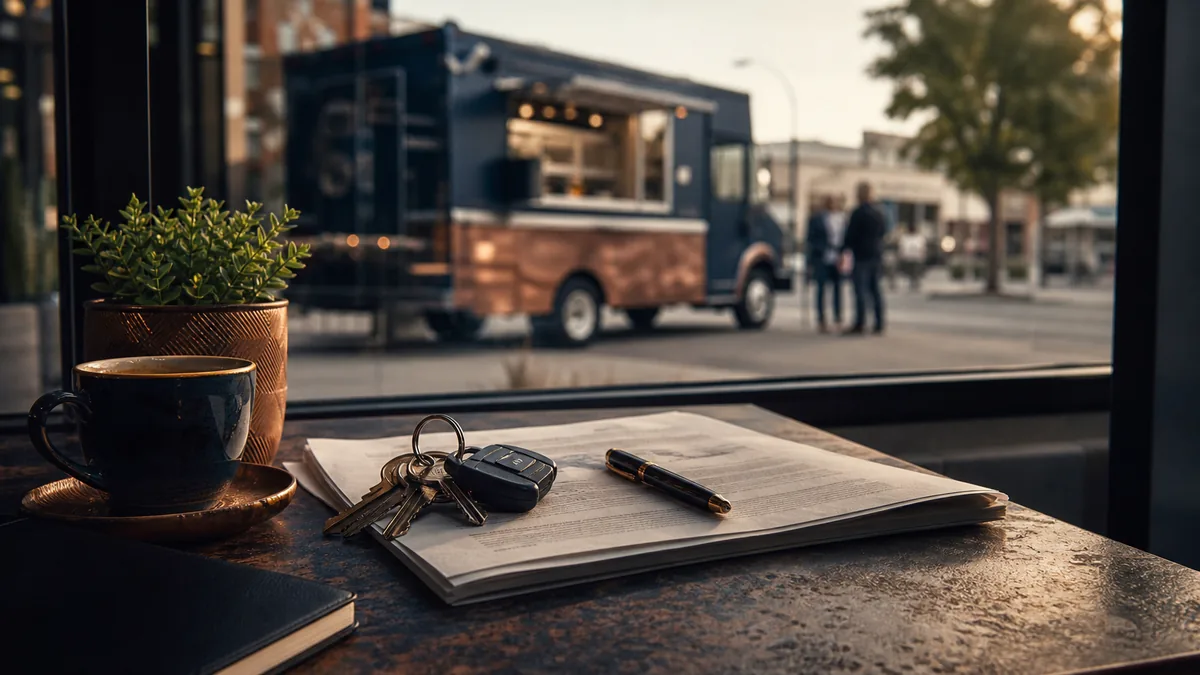
Franchising a mobile food truck means taking a business with no fixed address and forcing it into a legal framework — territories, permits, brand standards — that was built around businesses with one. That’s the core tension, whether you’re buying into a food truck franchise or trying to franchise your own truck concept. The legal obligations are the same as for any franchise: a food truck franchisor must prepare and deliver a Franchise Disclosure Document (FDD) under the FTC Franchise Rule just like a restaurant chain. But three issues hit mobile concepts harder than anyone expects: how you define a territory for a vehicle, where the food legally gets prepped, and the city-by-city permit patchwork.
This article covers both directions — evaluating a food truck franchise as a buyer, and franchising your own truck as an operator.
Why Food Trucks Are Structurally Hard to Franchise
A food truck looks like the simplest possible franchise: one vehicle, a small menu, low overhead. Legally, the mobility is exactly what makes it complicated.
Territory is the hardest drafting problem. Territory provisions in traditional agreements draw a radius or boundary around a fixed location. A truck has no fixed location — so what does “your territory” even mean? Mobile-concept agreements have to answer questions a restaurant agreement never faces: Where may the truck park and sell? Can it cross into another franchisee’s area for a festival? Who gets the rights to a catering job that originates in one territory and is served in another? Who controls high-value events, and can the franchisor allocate them through a booking system or app? Sloppy answers to these questions are a leading source of disputes in mobile systems.
Commissary requirements anchor the “mobile” business to a fixed place. Health codes generally don’t let a truck operate as a free-floating kitchen. In Texas, mobile food units are typically required to operate from a permitted central preparation facility (commissary) — an inspected fixed location where food is stored and prepped and the unit is serviced — with variance procedures available in limited cases. A franchise system has to decide whether franchisees find their own commissaries, use franchisor-designated ones, or build them, and the agreement must say so.
The permit landscape is a patchwork, not a system. There is no single statewide food truck license that covers everywhere a truck might sell. In Texas, many cities and counties run their own health departments and issue their own mobile food unit permits; where no local health authority exists, the Texas Department of State Health Services has jurisdiction. Practically, a truck that works events in several cities may need a permit (and an inspection, and fees) in each jurisdiction where it operates. A franchisor selling a “mobile” opportunity needs a permit playbook for this reality — and a buyer should ask to see it.
Vehicle standards replace build-out standards. In a brick-and-mortar system, the franchisor controls the premises through design specs. In a mobile system, the truck is the premises: who owns it, who maintains it, what happens when it breaks down for two weeks, when it must be refurbished or replaced, and what wrap and equipment standards apply all have to live in the franchise agreement.
Mobile vs. Brick-and-Mortar: How the Key Terms Compare
| Issue | Brick-and-mortar franchise | Mobile food truck franchise |
|---|---|---|
| Territory | Radius or boundary around a fixed site | Defined operating zone, event rights, and roaming/parking rules |
| Premises control | Approved site, lease, design specs | Vehicle ownership, maintenance, refurbishment, wrap standards |
| Health permits | One jurisdiction, one permit | Potentially one permit per city/county where the truck operates |
| Food prep | On-site kitchen | Permitted commissary/central prep facility required in most jurisdictions |
| Initial investment | Build-out typically the largest cost | Truck build-out typically lower than a restaurant build-out |
| Revenue ceiling | Seats, hours, and capacity of one site | One service window, weather, event calendar |
For Buyers: Reading a Food Truck FDD
A food truck franchise can genuinely cost less to enter than a restaurant franchise — no leasehold build-out, smaller equipment package. But the lower entry cost comes with a lower ceiling: one truck has one service window, no dining room, and a revenue line that moves with weather, events, and parking access. The FDD is where you test whether the economics and the legal structure hold up. Focus on:
- Item 7 (estimated initial investment). For a mobile concept this is dominated by the truck or trailer build-out, equipment, and wrap. Check whether the range assumes a new or used vehicle, who sources it, and whether commissary deposits and multi-jurisdiction permit fees appear in the table.
- Item 12 (territory). This is the make-or-break item for a mobile concept. Look for how the operating area is defined, whether it’s exclusive or merely “protected,” how festivals and catering outside the area are handled, and whether the franchisor allocates events or locations through a scheduling or app-based system. An Item 12 that reads like it was copied from a restaurant FDD is a red flag that the system hasn’t thought through mobility.
- The operational items. Required commissary arrangements, approved suppliers, vehicle maintenance and replacement obligations, and required technology.
Get the FDD professionally reviewed before you sign — for mobile concepts especially, the gaps matter as much as the disclosures.
For Operators: Franchising Your Own Truck Concept
If your truck has lines around the block and people keep asking how they can open one, franchising is a real path — but you become a franchisor, with every obligation that carries. Before you can sell a single franchise you must prepare an FDD compliant with the FTC Franchise Rule (plus state franchise laws where applicable), and you should expect to systematize three things a single-truck operator usually keeps in their head:
- Recipes and operations. Everything from prep procedures to service flow goes into a written operations manual a stranger could execute in another city.
- The commissary model. Decide how franchisees will satisfy central-prep requirements in their markets — and prove the model works somewhere other than your home base.
- The permit playbook. Document how to get permitted in a new jurisdiction: applications, inspection standards, fees, timelines. This playbook is much of what your franchisees are paying for.
You’ll also need to make the structural calls discussed above — territory definitions, event rights, vehicle ownership — before the FDD is drafted, because they shape Items 7 and 12 and the franchise agreement itself. Our startup franchising package is built for exactly this stage.
Frequently Asked Questions
Does a food truck franchisor need an FDD like any other franchisor?
Yes. The FTC Franchise Rule applies to mobile concepts the same as fixed-location ones. If you license your trademark, exert significant control or provide significant assistance, and charge a fee, you’re a franchisor and must deliver an FDD before signing or accepting payment.
How do franchise territories work for a food truck?
However the agreement says they work — there’s no default. Well-drafted mobile agreements define an operating zone plus separate rules for events, catering, and roaming. Read Item 12 and the territory clause closely; vague mobile territories invite conflict between franchisees.
Do I need a separate permit for every city my truck operates in?
Often, yes. In Texas, mobile food units are generally permitted by the local health authority in each jurisdiction where they operate, with the state health department covering areas without a local authority. Requirements and fees vary city to city, so confirm locally before committing to an event calendar.
Is a food truck franchise cheaper than a restaurant franchise?
The initial investment is typically lower because there’s no leasehold build-out. But factor in the commissary costs, multi-jurisdiction permits, vehicle maintenance and eventual replacement — and a single-truck revenue ceiling — when comparing returns rather than just entry price.
Whether you’re evaluating a food truck FDD or turning your own truck into a franchise system, the mobile-specific terms are where these deals succeed or fail. Reidel Law Firm handles FDD reviews, franchise launches, and franchise agreements for Texas and nationwide clients on flat-fee terms — talk to a franchise attorney before you commit to the road.