INTERNATIONAL TRADE LAW
PTA vs. FTA: What's the Difference for Importers?
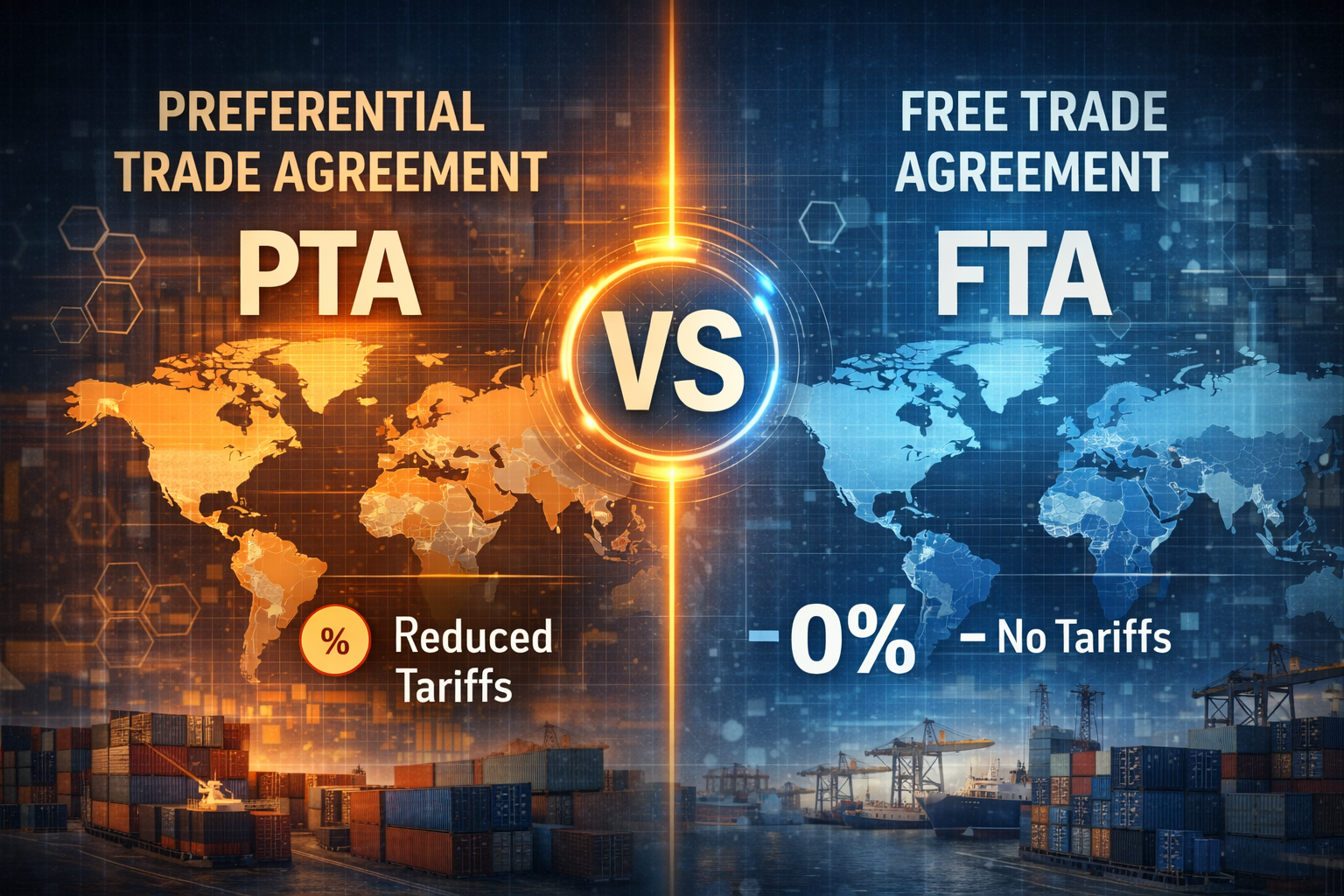
Every free trade agreement is a preferential trade agreement, but not every preferential trade agreement is an FTA. “Preferential trade agreement” (PTA) is the umbrella term for any arrangement that gives some countries’ goods better tariff treatment than the default MFN rate — it includes one-way preference programs like the Generalized System of Preferences (GSP) and limited “partial-scope” deals that cut tariffs on only a slice of products. A free trade agreement is the comprehensive version: a reciprocal treaty in which the parties eliminate duties on substantially all trade between them, the standard GATT Article XXIV sets for the arrangement to be lawful at the WTO.
The distinction matters in dollars. An FTA preference is a treaty right that lasts as long as the agreement does; a unilateral preference is a gift of the granting country’s legislature — and as US importers who relied on GSP learned when it lapsed at the end of 2020, gifts can be withdrawn.
PTA vs. FTA at a Glance
| Feature | PTA (umbrella concept) | FTA |
|---|---|---|
| Reciprocity | May be one-way (e.g., GSP) or partial | Always reciprocal |
| Product coverage | Can be a limited list of goods | Substantially all trade |
| Legal form | Statute or program of the granting country, or limited agreement | Binding international treaty |
| WTO basis | Enabling Clause (developing-country preferences) | GATT Art. XXIV (goods), GATS Art. V (services) |
| Durability | Can lapse or be revoked unilaterally | Lasts until withdrawal under treaty terms |
| US examples | GSP | USMCA, US–Korea, US–Chile |
What Is a Preferential Trade Agreement?
A preferential trade agreement is any arrangement granting tariff treatment better than MFN to particular countries. The category covers two main types.
Unilateral preference programs. A developed country lowers or zeroes duties on goods from developing countries, asking nothing in return. The WTO’s Enabling Clause makes this lawful despite the MFN rule. The flagship US example is GSP, which gave duty-free entry to thousands of products from designated developing countries — until its authorization expired on December 31, 2020. Congress has introduced reauthorization bills since, but as of mid-2026 GSP remains lapsed, and importers of formerly eligible goods have been paying full MFN duties for over five years.
Partial-scope agreements. Two or more countries (under WTO rules, developing countries relying on the Enabling Clause) exchange tariff cuts on a limited list of products rather than across the board. These are reciprocal but shallow — preference without comprehensiveness.
A terminology note: the WTO itself tends to reserve “preferential trade arrangements” for the unilateral programs and calls reciprocal deals “regional trade agreements” (RTAs). In ordinary business usage, PTA is the broad bucket and FTA is its most complete form.
What Is a Free Trade Agreement?
A free trade agreement is a reciprocal treaty in which two or more countries eliminate tariffs and reduce other barriers on substantially all trade between them, while each keeps its own external tariff toward the rest of the world — the feature that distinguishes an FTA from a customs union. Modern FTAs typically reach beyond goods into services, investment, intellectual property, digital trade, and dispute settlement.
The United States is currently party to 14 comprehensive FTAs covering 20 countries, including USMCA with Canada and Mexico and bilateral agreements with partners such as Korea, Australia, Chile, and Singapore. Because each FTA member keeps its own external tariff, every FTA needs rules of origin to make sure only goods genuinely produced in a partner country collect the preference.
How an Importer Actually Claims a Preference
Preferential rates are never automatic. Whether the source is an FTA or a preference program, a claim has three working parts.
| Step | What it involves | USMCA example |
|---|---|---|
| 1. Qualify the goods | Apply the agreement’s rules of origin — tariff-shift tests, regional value content, or wholly-obtained rules | Product-specific rules of origin in the agreement annexes |
| 2. Certify origin | Produce the certification or documentation the program requires | Certification of origin with nine minimum data elements — no prescribed form; importer, exporter, or producer may certify |
| 3. Claim and keep proof | Flag the entry with the program’s special program indicator (SPI) in HTSUS Column 1 “Special” and retain records for audit | Importer keeps the certification and supporting origin records for at least five years |
Step 1 is where claims fail. Rules of origin exist precisely because FTA members keep separate external tariffs — without them, third-country goods would enter through the lowest-tariff member and ride the preference. CBP can verify a claim years after entry, and an unsupported certification means repaid duties plus potential penalties. The flexibility of USMCA’s certification (any format, even the importer’s own) is convenient, but it shifts the documentation burden squarely onto whoever signs.
What Happens When a Preference Program Lapses
GSP is the cautionary tale. When its authorization expired at the end of 2020, the preference vanished overnight: importers of eligible goods went from duty-free to full Column 1 MFN rates, with industry groups estimating the added cost in the billions of dollars. In past lapses Congress renewed the program retroactively and importers were refunded duties paid during the gap — without interest — so many importers continue flagging eligible entries to preserve refund claims if that pattern repeats. But more than five years on, renewal remains pending, and no refund is guaranteed.
The lesson for sourcing strategy: a unilateral preference is a program, not a promise. If your landed-cost margin depends on a preference, know which kind it is — treaty-based FTA rates survive political cycles far better than statutory programs that need periodic reauthorization.
Frequently Asked Questions
Is an FTA a type of PTA?
Yes. PTA is the umbrella term for any better-than-MFN tariff arrangement. An FTA is the most comprehensive type — reciprocal and covering substantially all trade. GSP-style programs are PTAs that are not FTAs.
Is GSP still lapsed?
Yes. GSP authorization expired December 31, 2020, and as of mid-2026 Congress has not renewed it. Formerly eligible goods pay normal MFN duty rates. Past renewals have been retroactive with duty refunds, but renewal and refunds are not guaranteed.
Do I need a certificate to claim an FTA rate?
You need whatever the specific agreement requires. Under USMCA there is no prescribed form — a certification containing nine minimum data elements suffices, and the importer, exporter, or producer may complete it — but you must keep the records that prove origin.
What is a partial-scope agreement?
A reciprocal trade deal that cuts tariffs on only a limited list of products rather than substantially all trade. The WTO permits them among developing countries under the Enabling Clause.
Whether your duty savings rest on an FTA claim or a preference program determines your documentation burden and your risk if the rules change. Reidel Law Firm reviews preference eligibility, rules of origin, and claim documentation for importers at a transparent flat fee — get a flat-fee compliance memo before your next entry.