INTERNATIONAL TRADE LAW
What to Do When CBP Seizes Your Imported Goods

If U.S. Customs and Border Protection (CBP) seizes your imported goods, you generally have 30 days from the date on the seizure notice to respond — and the option you choose decides whether you get the goods back, pay to recover them, or lose them to forfeiture. Missing that window is the most common and most expensive mistake importers make. This guide walks the timeline from detention to seizure and the four responses available to you.
Detention comes first, then seizure
A seizure rarely happens out of nowhere. It usually starts with a detention — CBP holds your shipment at the port or a Centralized Examination Station while it decides whether the goods are admissible.
The timeline is set by statute. CBP has up to 30 days from the date the merchandise is presented for examination to make an admissibility decision (19 U.S.C. § 1499). If CBP decides to detain, it must send you a notice of detention within five business days of that decision, telling you why the goods are held and what it needs from you. Respond quickly and completely — supplying the requested information is often your best and cheapest chance to get the shipment released before it ever becomes a seizure.
If CBP neither releases nor formally acts within the 30-day window, the goods are treated as “deemed excluded,” which gives you the right to file a protest. If CBP instead finds a violation, the detention converts to a seizure.
What a notice of seizure tells you
Once goods are seized, CBP’s Fines, Penalties & Forfeitures (FP&F) office at the port issues a Notice of Seizure and Information to Claimants. It identifies the goods, cites the specific statute authorizing the seizure, and states your deadline to respond. For a deeper walkthrough of the document itself, see what a customs notice of seizure looks like.
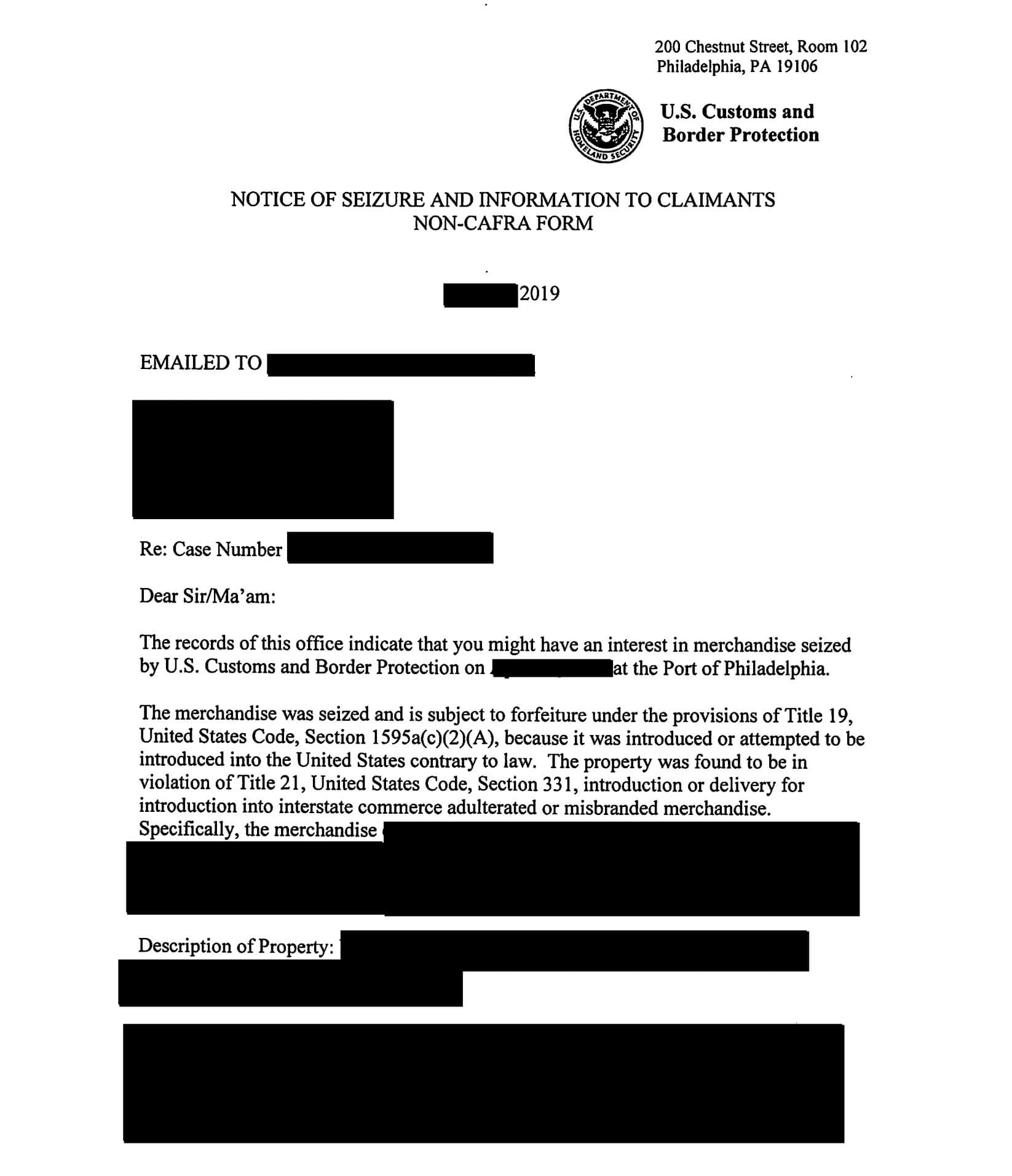
A real CBP Notice of Seizure (redacted). The form type and the cited legal basis at the top control your deadlines and which options apply.
One detail on the notice matters a great deal: whether it is a CAFRA or non-CAFRA form. The Civil Asset Forfeiture Reform Act (CAFRA) governs many seizures and sets its own deadlines for forcing the case into federal court; customs revenue, intellectual-property, and certain other seizures are non-CAFRA and run under the Tariff Act (19 U.S.C. §§ 1600 et seq.). The form tells you which track you are on.
Your four options — and the 30-day clock
Accompanying the notice is an Election of Proceedings form. You generally must respond within 30 days from the date the notice is mailed (19 CFR 171.2). You have four choices:
| Option | What it means | When it fits |
|---|---|---|
| Petition for relief | Ask FP&F to remit or mitigate the forfeiture (return the goods, often on payment of a reduced amount) | You believe the seizure was wrong, or you want to negotiate the goods back |
| Offer in compromise | Offer a sum to settle the matter under 19 U.S.C. § 1617 | You want a faster, negotiated resolution |
| Abandon the goods | Take no action and let the property be forfeited | The goods are worth less than the cost and risk of recovering them |
| Request court action | File a claim (and, where required, a cost bond) to push the case to a U.S. federal court | You want a judge — not the agency — to decide |
The petition for relief is the most common path. It does not go to court; FP&F reviews your written argument and supporting evidence and can return the goods, often conditioned on paying a mitigated amount and fixing the underlying violation. You can request an extension before the 30 days run, but do not assume one will be granted — calendar the deadline the day the notice arrives.
Why the negotiation is rarely simple
Recovering seized goods usually means fixing whatever caused the seizure — a misclassification, a marking or labeling failure, a missing partner-agency clearance, an intellectual-property problem, or an undervaluation. CBP will not release a shipment simply because you are new to importing or the mistake was honest. The longer the goods sit, the longer your capital is tied up and the more storage and demurrage accrue, so treating the violation as a top priority protects both the merchandise and your supply chain.
A seizure is also a signal. The same facts that triggered it can lead to a separate penalty case under 19 U.S.C. § 1592, so how you respond to the seizure can affect your wider exposure. Because the notices use precise legal terms and tight deadlines, most importers are better served getting trade counsel involved before they respond rather than after.
FAQ
How long does CBP have to detain my shipment? Up to 30 days from the date the goods are presented for examination. If CBP has not made an admissibility decision by then, the merchandise is “deemed excluded” and you can file a protest.
How long do I have to respond to a seizure notice? Generally 30 days from the date the notice is mailed. The Election of Proceedings form lets you petition, offer a compromise, abandon the goods, or request that the matter go to court.
Will filing a petition get my goods back? It can. A petition asks FP&F to remit or mitigate the forfeiture; relief is often granted on payment of a reduced amount and correction of the underlying violation, but it is not guaranteed.
What happens if I do nothing? The goods proceed to forfeiture and you lose them. Doing nothing is only sensible when the merchandise is worth less than the cost of recovering it.
Importing into the US? Reidel Law Firm prepares flat-fee Import/Export Compliance Memos and advises importers on detentions, seizures, and penalty cases — with direct access to the trade attorney handling your matter. Request a compliance memo →