INTERNATIONAL TRADE LAW
Customs Notice of Seizure: What It Is & How to Respond
A customs notice of seizure is a formal letter from U.S. Customs and Border Protection (CBP) telling you the government has taken your merchandise because it believes the goods were imported in violation of U.S. law. The letter starts a clock: in most cases you have 30 days from the date the notice was mailed to file a petition if you want your goods back. Do nothing, and the property is forfeited — permanently, and without compensation.
This guide explains what the notice contains, the four ways you can respond, the deadlines attached to each, and what happens if you miss them.
What a Notice of Seizure Contains
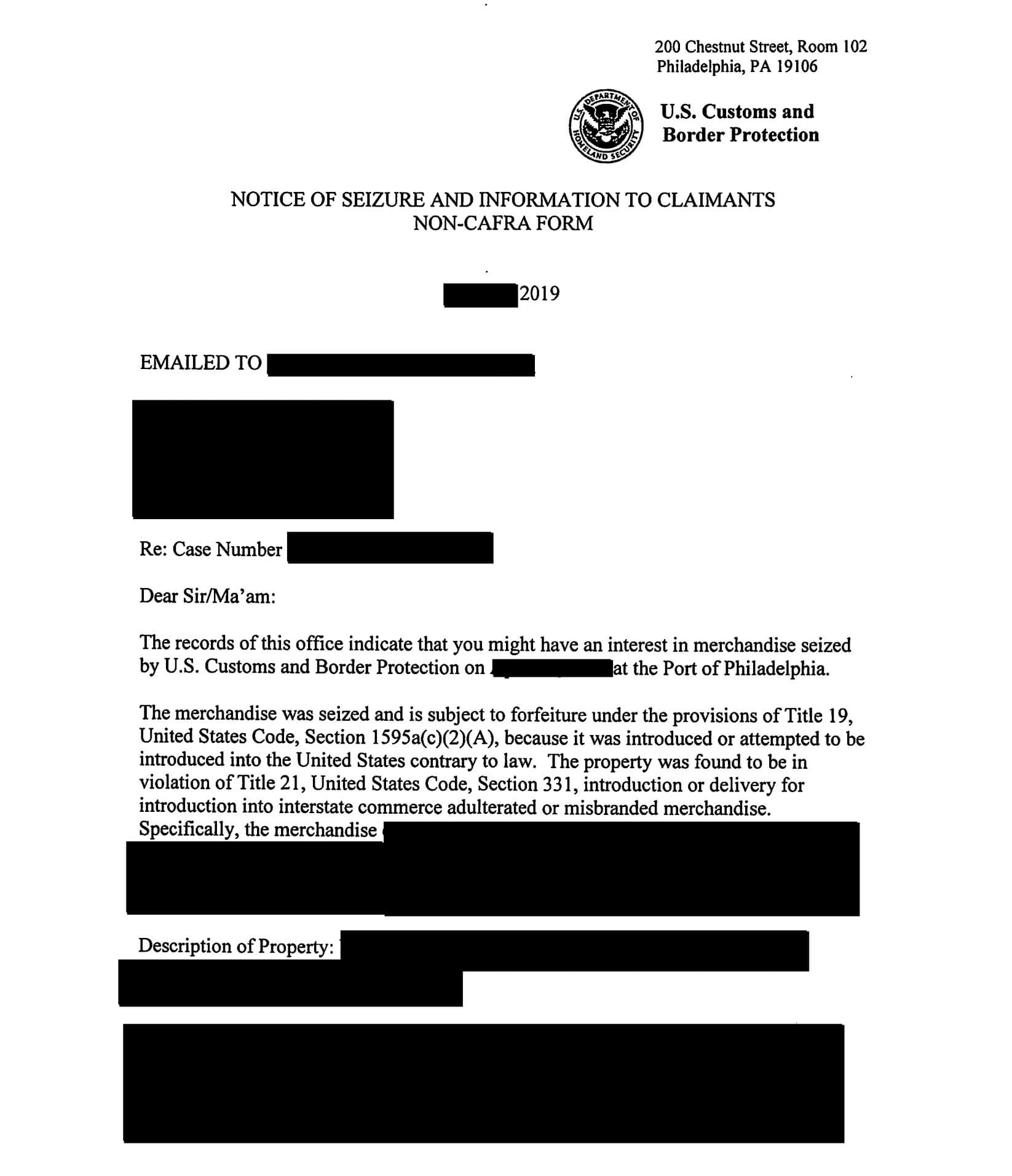
The seizure letter comes from the Fines, Penalties & Forfeitures (FP&F) office at the port where your goods were taken. Here is an actual notice of seizure (redacted) received by one of our clients:
A real CBP Notice of Seizure (redacted). Note the form title — “Non-CAFRA Form” — and the cited legal basis for the seizure, both of which determine your deadlines and options.
Every notice will include:
- The FP&F case number that identifies your seizure in CBP’s system.
- A description of the seized merchandise and its appraised value.
- The legal basis for the seizure — the specific statutes or regulations CBP believes were violated.
- An Election of Proceedings form listing your response options.
- The deadline to respond, typically 30 days from the date of mailing.
The cited legal basis matters more than anything else in the letter. It tells you what CBP thinks went wrong — undervaluation, misclassification, country-of-origin issues, intellectual property violations, missing permits — and that determines which response gives you the best chance of recovery.
Why CBP Seizes Goods
CBP has statutory authority to seize merchandise it has reasonable cause to believe was brought into the United States contrary to law. The most common triggers for commercial importers are misclassification or undervaluation of goods, false country-of-origin markings, suspected counterfeit or trademark-infringing merchandise, missing licenses or permits required by partner government agencies (FDA, EPA, CPSC and others), and unpaid antidumping or countervailing duties. Seized goods are moved to a secure facility and held while the case is resolved.
Your Four Response Options
The Election of Proceedings form gives you four paths. You choose exactly one, and your choice shapes everything that follows.
1. File a Petition (the most common path)
A petition for remission or mitigation asks CBP — administratively, without going to court — to return the goods or reduce the penalty. You explain the facts, attach supporting evidence, and argue either that no violation occurred or that mitigating circumstances justify relief.
Under 19 CFR 171.2, the petition must be filed within 30 days from the date the notice of seizure was mailed. The FP&F officer can grant extensions in some circumstances, but never count on one. A petition is usually the fastest and least expensive route, and if the petition is denied in whole or part, a supplemental petition is possible.
2. Make an Offer in Compromise
An offer in compromise proposes a settlement: you pay an agreed amount, and CBP releases the goods or resolves the claim. It can make sense where there was a genuine violation but litigation risk or business disruption makes settlement the cheaper outcome. The offer must be made before forfeiture is complete, and CBP is under no obligation to accept it.
3. Abandon the Goods
If the merchandise isn’t worth the fight — low value, perishable, or the violation is clear — you can abandon it. The goods are forfeited and the case ends. Be aware that abandonment doesn’t necessarily end your exposure: penalties can still follow, and the seizure stays in CBP’s records, which can mean heightened scrutiny of your future shipments.
4. Demand Judicial Forfeiture Proceedings (court)
You can bypass CBP’s administrative process and force the government to prove its case in federal court. For seizures under the customs laws (Title 19), you file a claim and post a bond of $5,000 or 10% of the value of the claimed property, whichever is lower (minimum $250), under 19 U.S.C. § 1608. The case is then referred to the U.S. Attorney for judicial forfeiture proceedings.
One nuance worth knowing: the deadlines for court claims differ by the type of seizure. Customs-law seizures follow Title 19’s rules — a claim filed with the FP&F officer within the period stated in your notice (and within 20 days of CBP’s first published notice of intent to forfeit). Seizures under other statutes — currency seizures are the common example — fall under the Civil Asset Forfeiture Reform Act (CAFRA), which sets a claim deadline of at least 35 days from the mailing of the notice. Your seizure letter states which rules govern your case — the sample notice pictured above says “Non-CAFRA Form” right in the heading — and this is one of the first things an attorney will check.
Court is the most expensive option and usually the slowest. It makes sense when the goods are valuable, CBP’s legal position is weak, and you can carry the litigation cost.
What Happens If You Ignore the Notice
Nothing good. If you don’t respond by the deadline, CBP treats the silence as abandonment and completes the forfeiture by default. The consequences:
- The goods are gone. Forfeited merchandise is destroyed, auctioned, or otherwise disposed of, with no compensation to you.
- Penalties can still be assessed against the importer even after the goods are forfeited.
- Your record follows you. A forfeiture sits in CBP’s enforcement history, and importers with seizure records routinely see more exams, more holds, and slower clearances on subsequent shipments.
Detention Is Not Seizure — and It’s Your Early Warning
Before most seizures, there’s a detention. Under 19 U.S.C. § 1499, CBP must decide whether to release or detain merchandise within 5 working days of presentation for examination, and must send a detention notice within 5 working days of the decision to detain. If CBP makes no final admissibility determination within 30 days, the merchandise is treated as excluded — which itself triggers protest rights.
The detention window is your best opportunity to head off a seizure. Responding quickly with the documentation CBP asks for — proof of value, origin records, permits, licensing — resolves many detentions before they escalate. If you’ve found an error in your own entry, a Post Summary Correction can fix it, but only within 300 days of entry (or 15 days before scheduled liquidation, whichever comes first).
Preventing the Next Seizure
Most commercial seizures trace back to compliance gaps that were fixable in advance: wrong tariff classifications, sloppy valuation, unverified country-of-origin claims, or missing agency permits. CBP’s “reasonable care” standard expects importers to get these right, and exercising it is the cheapest insurance you can buy. An import/export compliance review that audits your classifications, valuation practices, and documentation before CBP does is worth far more than the best seizure defense after the fact.
Frequently Asked Questions
What is a customs notice of seizure?
A customs notice of seizure is a formal letter from CBP’s Fines, Penalties & Forfeitures office notifying you that your merchandise has been seized for a suspected violation of U.S. import law. It states the legal basis for the seizure and starts the deadline for you to respond.
How long do I have to respond to a CBP seizure letter?
In most cases, 30 days from the date the notice was mailed to file an administrative petition. Deadlines for court claims differ depending on whether the seizure falls under the customs laws or CAFRA — your notice states which applies. Check your specific letter and calendar every date in it immediately.
Can I get seized goods back from customs?
Often, yes. A petition for remission or mitigation is the most common path, and CBP regularly returns goods or reduces penalties where the importer shows the violation didn’t occur or was unintentional and the importer presents a credible compliance picture.
What happens if I ignore a customs seizure letter?
The goods are forfeited by default — destroyed or auctioned with no compensation — penalties may still follow, and the seizure record typically increases CBP scrutiny of your future shipments.
Do I need a lawyer for a customs seizure?
For commercial shipments of any real value, it’s strongly advisable. The deadlines are short and unforgiving, the petition is a legal argument rather than a complaint form, and choosing the wrong option on the Election of Proceedings form can permanently close better paths. An experienced trade attorney can also spot procedural defects in the seizure itself.
If CBP has seized your shipment, the clock is already running. Reidel Law Firm handles customs seizure responses and import compliance for businesses nationwide — contact us before your deadline passes.